
Lead Time
Modeled channel lead time in weeks. CPU is the shortest; GPU (accelerator) is longer; HBM (RAM) is the longest.
Lead time is collected from channel research and survey bands, then modeled as the number of weeks needed to deliver a CPU, GPU, or HBM order. The model starts from a 2025 standard, adjusts with coverage and a market-regime factor, and provides modeled weeks alongside low, mid, and high survey bands.
Companies considered are the major CPU, GPU, and HBM suppliers represented in the Demand and Supply pages: Intel, AMD, NVIDIA, SK hynix, Samsung, Micron, and the relevant captive ASIC programs. Lead time describes market availability, not an individual vendor’s customer-commitment schedule.
A longer lead time means a tighter market. Buyers must place orders earlier, allocation is more common, and vendors have more pricing power. When modeled weeks rise above the survey band, the stack is tightening faster than channel reports. Shorter lead times mean product is easier to get, delivery pressure fades, and spot premiums usually compress.
CPU vs accelerator vs RAM lead time
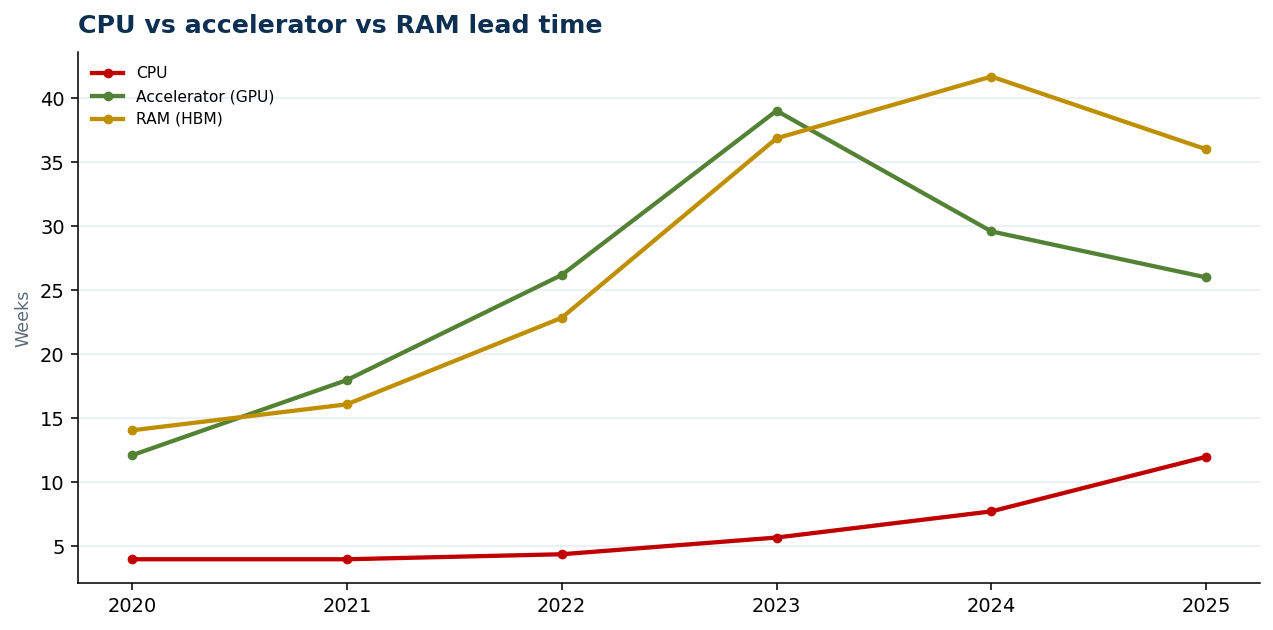
Modeled channel lead time. CPU is shorter than GPU; HBM is the longest (binding constraint).
Download PNG · Through 2025
CPU channel lead time
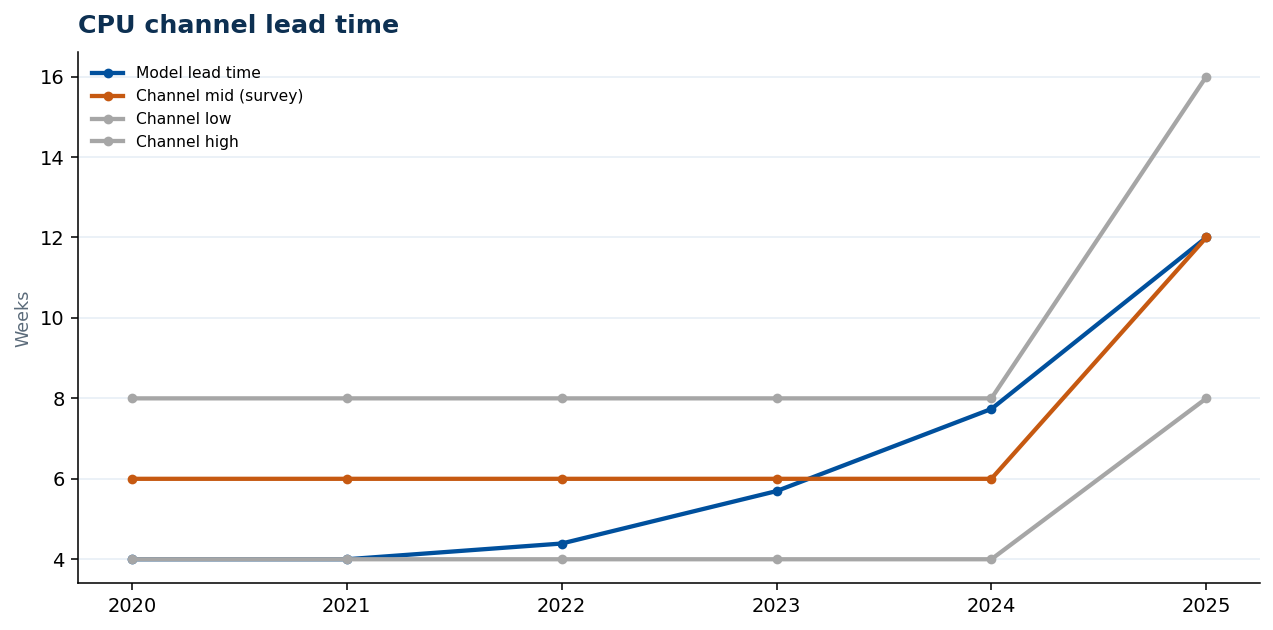
Modeled CPU channel lead time versus the research survey band.
Download PNG · Through 2025
Accelerator lead time (GPU)
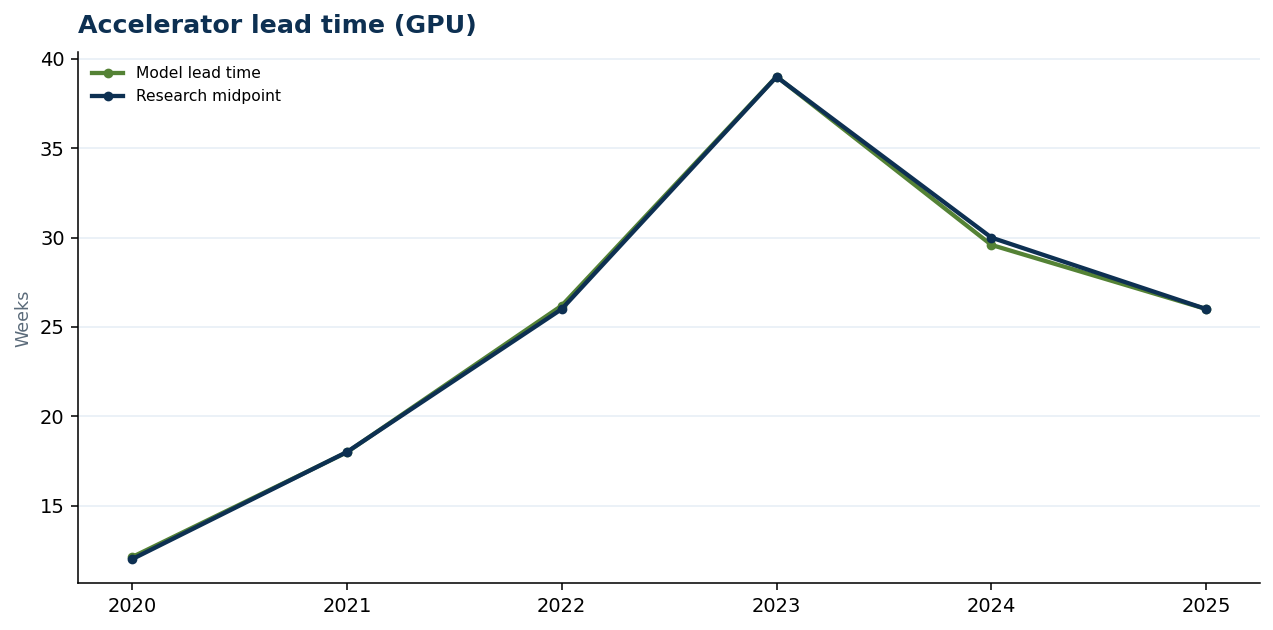
HGX / Hopper–Blackwell channel lead time. 2025 standard = 26 weeks. Dashed = research midpoint.
Download PNG · Through 2025
Last model update:
How to interpret this data
Use this signal with the underlying Demand and Supply pages before drawing conclusions about pricing power, availability, or spending momentum.
Related data
Frequently asked questions
What does this page measure?
Modeled channel lead time in weeks. CPU is the shortest; GPU (accelerator) is longer; HBM (RAM) is the longest.
Can JP Data provide a custom company, product, region, or scenario cut?
Yes. Request custom data with the required market boundary, products, companies, geography, and time horizon.