
This dataset is a worldwide model of the enterprise SSD market. An enterprise SSD is the NAND drive sold into servers and storage systems, including the high-capacity QLC drives used for AI data and the TLC drives used for general servers. Samsung, SK Group with Solidigm, Micron, Kioxia, and SanDisk are the suppliers that carry the forecast. Client SSDs, cards, USB, hard drives, DRAM, HBM, Optane, and array vendors’ system revenue are not in this dataset. The data is provided starting in 1994 and forecasts through 2032. In 2025, we estimate $27.81 billion of enterprise SSD revenue, about 275 exabytes at $101 a terabyte. From 2026 the same market is carried forward on three paths that share a downside, base, and upside case.
The market, 1994–2032
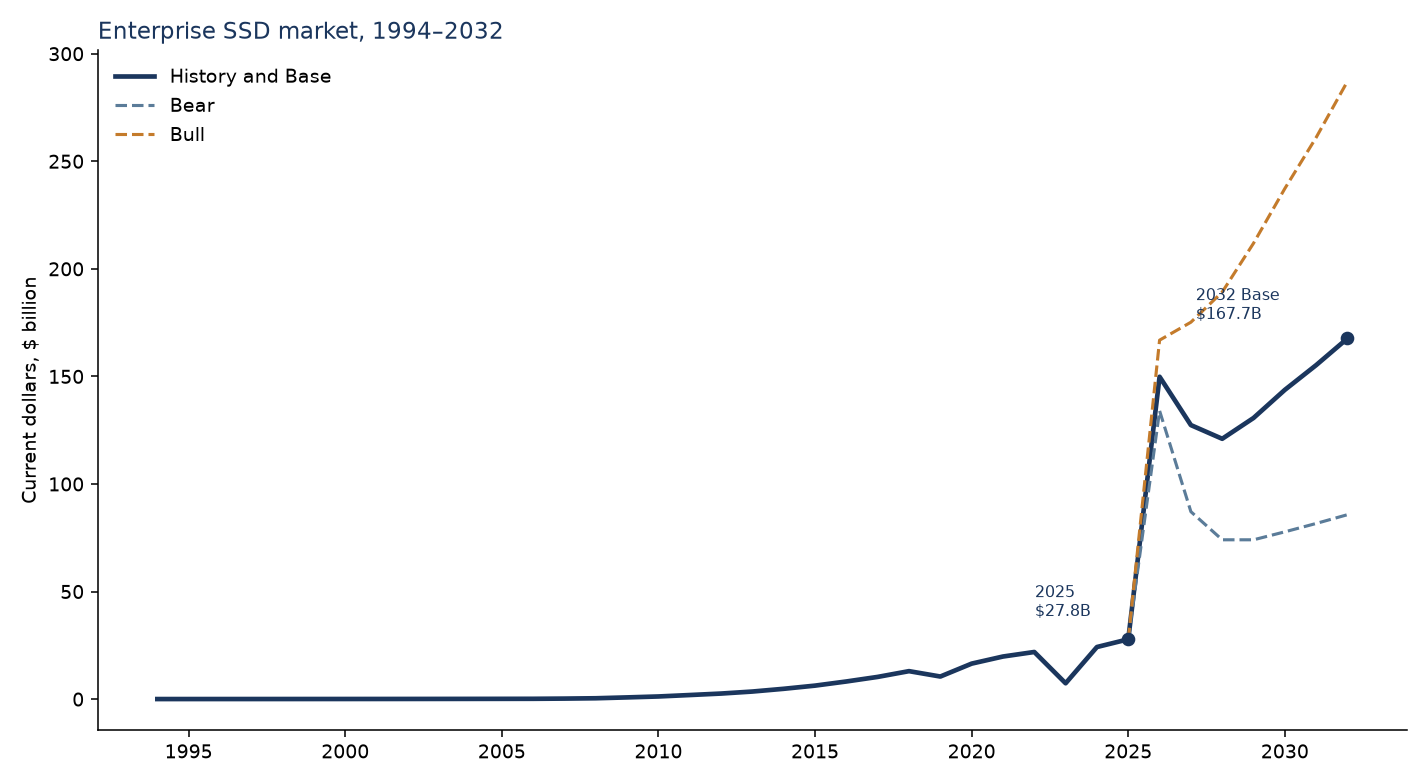
In 2025 the market was $27.81 billion. The base path for 2026, still an open year, steps up to $149.8 billion because the first half is already larger than 2025. Our base forecast is $167.7 billion in 2032, with $143.8 billion at the 2030 checkpoint, below 2026, as the market gives back part of that spike. The downside case ends at $85.7 billion. The upside case ends at $287.2 billion. These figures are drive revenue, not the storage systems wrapped around the drives.
Data set details
The model. The market model separates history through 2025 from the forecast levers. Exabytes are revenue divided by the blended price per terabyte. The 2025 price is $101 a terabyte. On the base path the blended price is $220 a terabyte in 2026 and $75 in 2032, so bits keep rising even where the dollars pause.
The forecast. The data is provided for revenue, exabytes, price, vendor share, workload, and region. The forecast holds 2026 through 2032 for downside, base, and upside. All three paths share the 2025 market history. The compound rate from 2026 to 2032 on the base path is 1.9 percent.
Key players. Five groups carry the 2026 dollars: Samsung at $54.4 billion, SK Group including Solidigm at $32.7 billion, Micron at $26.5 billion, Kioxia at $17.5 billion, and SanDisk at $11.2 billion. China and other SSD vendors are the remainder. Controller companies are named and do not get a revenue share. The vendor list has 52 names. Most of them do not have a revenue column.
Key buyers and segments. The market is segmented by interface, NAND type, and workload. On the shared mix, NVMe is 84 percent of 2026 revenue and 93 percent in 2032. QLC is $50.9 billion in 2026 and $85.5 billion in 2032. AI and high-capacity workloads are 58 percent, then 72 percent. General-server TLC is the rest. End demand, not vendor headquarters, is 46 percent United States and Canada in 2026 and 42 percent in 2032. China is 22 percent, then 26 percent. Europe is 15 percent, then 14 percent.
The products. The catalog is PCIe 4 and PCIe 5 TLC, plus a QLC capacity line. Examples already shipping include Samsung’s PM1743, Solidigm’s D5-P5336 up to 61.44 TB, Micron’s 9550, and Kioxia’s CM7. Capacities on the sheet are the published upper point. A blank specification means it was not published for that row.
Narratives and documents. The data set is accompanied by articles that explain the forecast methodology and assumptions, the market drivers, the challenges, the forecast, the companies, and the events to watch.