
This dataset is a worldwide model of neocloud and Tier-2 GPU rental. The thing being counted is rented accelerator capacity and the managed software sold with it: reserved clusters, on-demand and spot GPU-hours, broker spreads, miner conversions that sell GPU-hours, and telco and sovereign GPUaaS. AWS, Azure, GCP, and Oracle are not in this dataset. OpenAI and Anthropic chatbot and API subscriptions, colocation or power rent that is not a GPU-hour, and captive lab clusters that never hit a rental income statement are also out. The data starts in 2023 and forecasts through 2032. In 2025, the total market was $12 billion. From 2026 the same market is carried forward on three paths: downside, base, and upside. 2026 is modeled from public guidance. 2027 through 2032 are modeled.
The market, 2023–2032
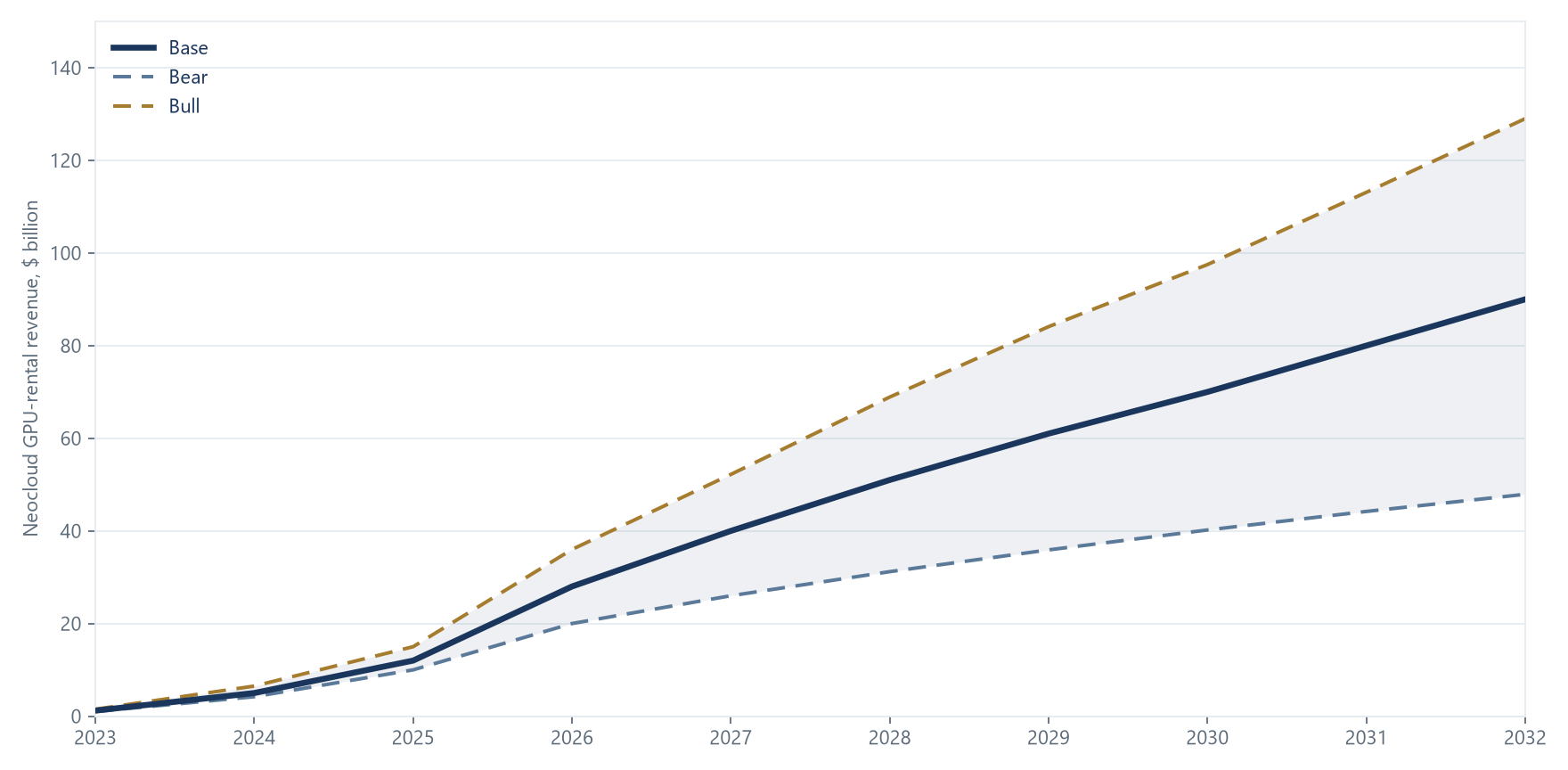
Market history is $1.2 billion in 2023, $5.0 billion in 2024, and $12 billion in 2025. The 2025 figure sits above a disclosed public floor of $5.63 billion, CoreWeave’s $5.131 billion fiscal-2025 revenue plus Nebius AI Cloud’s $480 million. On the base path the market is $28 billion in 2026, $70 billion in 2030, and $90 billion in 2032. The downside case ends at $47.9 billion in 2032. The upside case ends at $129 billion. The 2025–2030 base compound rate is about 42 percent, and the step after 2030 is an explicit fade.
Data set details
The model. Every forecast, split, and chart is a formula. The yellow cells with blue text on Assumptions are the levers. A cross-check restates revenue as GPUs times hours in a year times utilization times price per GPU-hour. Capital expenditure and chip sales are kept separate and are never added to rental revenue.
The forecast. The forecast holds downside, base, and upside revenue and year-over-year growth for every year from 2023 through 2032, plus the disclosed public floor where one exists. 2026’s guided public floor is $16.1 billion. 2023 through 2025 are market history. 2026 is modeled from guidance, and 2027 through 2032 are modeled.
Key buyers and segments. Geography splits the total across North America, Europe, China, the rest of Asia-Pacific, the Middle East and Africa, and Latin America. Workload splits it across training, fine-tuning, and inference. Segment splits it across Giants, emerging neoclouds, sovereign and telco clouds, brokers, and miner conversions.
Key players. The census names 87 entities, of which 61 are GPU operators. It records funding, active power, capital expenditure, and locations where those were disclosed. Named campuses and offtakers sit on their own sheet. Operator megawatts and landlord megawatts are the same physical load when one rents halls from the other, so they are not added.