
This dataset is a worldwide model of the general-purpose humanoid robot market. The Humanoid robot is defined as a machine that mimics a humanoid body: a full-size biped, a compact biped, or a wheeled base carrying a head, torso, and two arms, sold or separately or together for research, education, entertainment, or the home. Tesla’s Optimus, Figure’s fleet, and Agility’s leased Digits are some of the examples. Industrial arms, mobile robots without a humanoid body, and exoskeletons are NOT considered in this dataset. The data is provided starting 2024 and forecasts through 2032. In 2025, we estimate $529 million of humanoid robot revenue with 18,000 robots shipped, with an estimated average sales price of $29,400 a robot. From 2026 the same market is carried forward on three paths that share downside, base and upside case scenario.
The market, 2024–2032
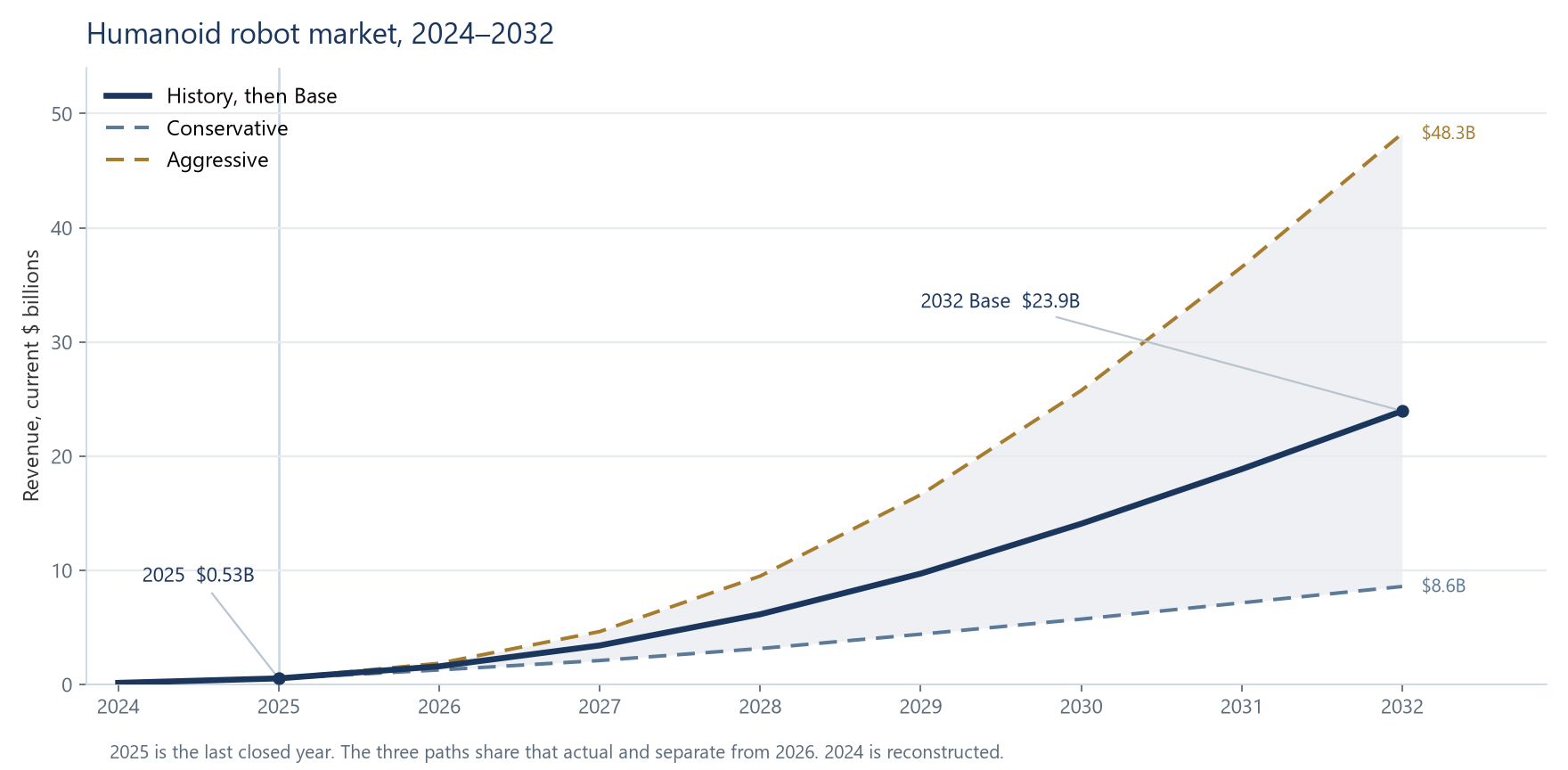
The humanoid robot market in 2024 market was only about $135 million on roughly sales of 3,000 robots.By 2025, the market reached $529 million with a sales volume of 18,000. Our base forecast for the market is $23.9 billion in 2032, a 72 percent compound rate from 2025, with $14.1 billion at the 2030 checkpoint. The downside case, in which pilots stall and research and entertainment stay the core of demand, ends at $8.6 billion. The upside case, in which Tesla, Hyundai, Figure, and the Chinese leaders all reach volume and home robots arrive early, forecasts the market to reach $48.3 billion. Note that these numbers do not include the software, data, or services sold around the robots.
Data set details
The model. The market model is built from the bottom up. All the assumptions are listed on the Assumptions sheet. The data lists every humaniod robot company, including AgiBot, Unitree, and UBTech and estimates their revenue. That price is a published list price where one exists, or our best estimate if it doesn't exist.
The forecast. The data is provided for: revenue, robots, average price, named-vendor dollars, and cumulative robots. The forecast holds 2026 through 2032 for downside, base, and upside case: revenue, year-over-year growth, average price, robots, and the cumulative installed base.
Key players. We consider the following companies in the forecast: AgiBot, Unitree, UBTech, Tesla, Figure AI, Agility Robotics, Boston Dynamics, Apptronik, 1X, XPeng, Galbot, Leju, Booster, Noetix, EngineAI, Fourier, and everyone else grouped together. Base revenue is published every year from 2025 to 2032, whereas downside and upside projections are published for the year 2032. A wider set of 37 profiles covers merchants, captives, entrants, an exited pioneer, and the out-of-scope names that mark the boundary.
Key buyers and segments. The market is segmented by buyer (research, education, and data collection; entertainment and guided service; manufacturing; logistics and warehousing; home and personal care), five deployment regions (China, North America, Europe, Japan and Korea, the rest of the world), and three form factors (full-size biped, compact biped, wheeled humanoid). Each has a 2025 share and a 2032 share in every scenario.
The products. The product catalog has 48 humanoids from Honda’s 2011 ASIMO to the robots shipping in 2026, with height, weight, degrees of freedom, hand dexterity, payload, runtime, speed, compute, and list price where those were published. The roadmap has 25 announced robots and production lines, researched in October 2026, each with its source. A blank cell means the maker has not published that specification.
The engineering details. A Specs sheet tracks the average price path by scenario, bill-of-materials anchors, the cheapest catalogued full-size and compact list prices, the highest published degrees of freedom and runtime by year, and the production capacity makers have announced.
Narratives and documents The data set is accompanied by several articles, that explain the forecast methodology and assumptions, the market drivers, the challenges, the forecast, the companies, the events to watch out for, and the roadmap.