
This dataset is a worldwide model of the data-center DRAM market. Data-center DRAM is defined as server modules, high-bandwidth memory sold into accelerators, CXL memory, and the small SOCAMM and custom-module line. SK hynix, Samsung, and Micron carry nearly all of the dollars. Phone LPDDR, PC modules, client GDDR, and NAND are not in this dataset. Module-maker sales are not added on top of chip revenue. The data is provided starting in 1994 and forecasts through 2032. In 2025, we estimate $72.6 billion of data-center DRAM revenue, 55 percent of a $132 billion DRAM industry total. From 2026 the same market is carried forward on three paths that share a downside, base, and upside case.
The market, 1994–2032
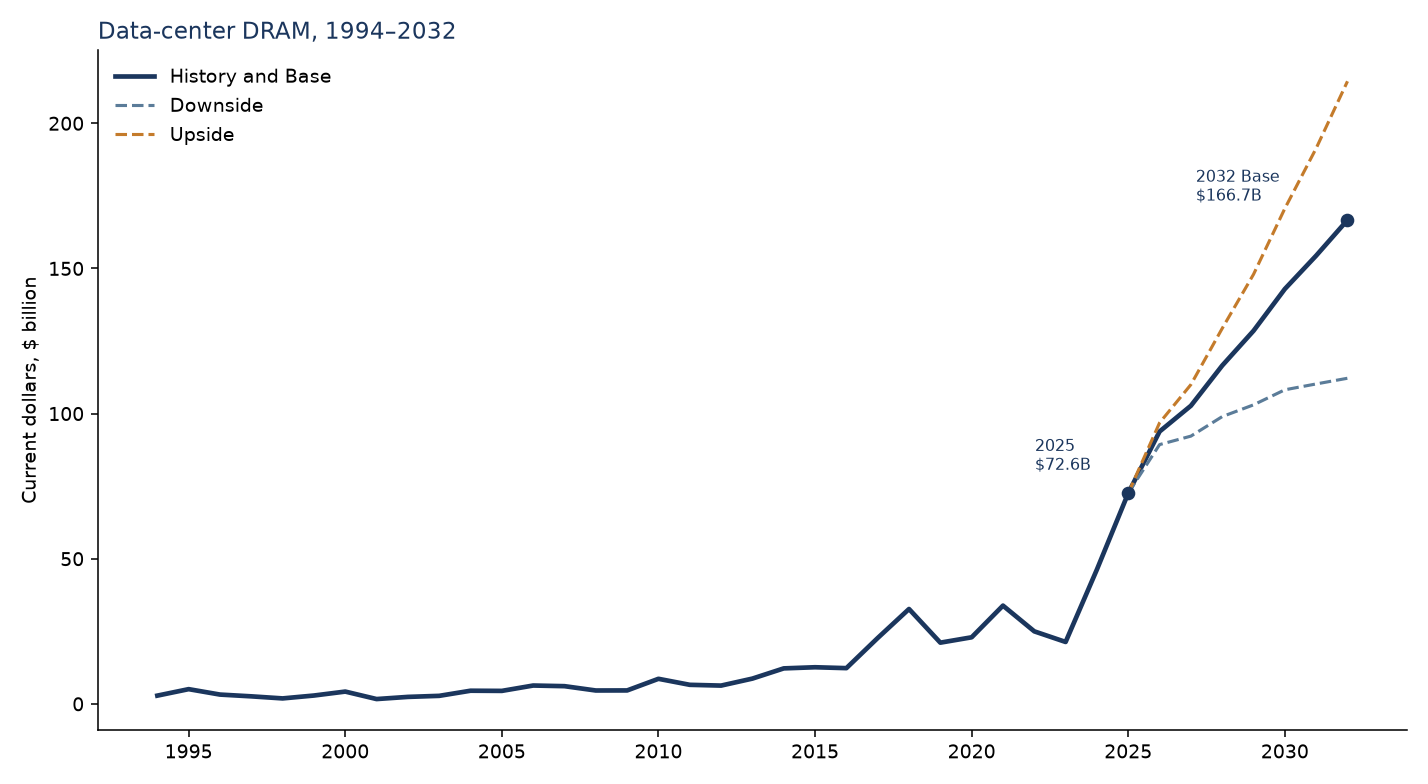
In 2025 the market reached $72.6 billion. Our base forecast is $93.8 billion in 2026 and $166.7 billion in 2032, a 12.6 percent compound rate from 2025, with $142.9 billion at the 2030 checkpoint. The downside case ends at $112.2 billion. The upside case ends at $214.5 billion. On the base mix, high-bandwidth memory rises from 40 percent of 2025 to 45 percent of 2032, while server modules remain the other large piece.
Data set details
The model. The market model is built from chip revenue, not from a second count of the modules those chips are sold in. Assumptions hold the levers. A $13.3 billion module market in 2024 is an anchor and is not added, because those dollars are already in the chip suppliers’ revenue. Module shipments and average selling price are blank.
The forecast. The data is provided for revenue by year, segment, vendor, and region. The forecast holds 2026 through 2032 for downside, base, and upside: revenue and the mix of HBM, server modules, MRDIMM, CXL, and the smaller lines. All three paths share the 2025 total market.
Key players. Three wafer suppliers carry the 2025 dollars: SK hynix at $27.6 billion, Samsung at $24.7 billion, and Micron at $17.4 billion. Together they are 96 percent of the 2025 pool. CXMT is $1.5 billion in 2025. Nanya is $0.7 billion. Base revenue for the large suppliers is carried through 2032. Module houses do not get a revenue line.
Key buyers and segments. The market is segmented by product (HBM, RDIMMs and legacy DIMMs, MRDIMMs, CXL, LRDIMMs, and the SOCAMM and custom-module line) and by buyer region. North American buyers are 49 percent in 2025 and 46 percent in 2032. China is 19 percent, then 21 percent. Europe holds 12 percent. On the base path, HBM moves from $29.0 billion in 2025 to $75.0 billion in 2032, and RDIMMs and legacy DIMMs from $31.9 billion to $46.7 billion.
The products. The catalog includes a DDR5 RDIMM, an MRDIMM, an HBM3E stack used on current accelerators, a 3DS RDIMM, and LPDDR on SOCAMM for Grace-class hosts. Peak bandwidth on the sheet is data rate times bus width. A blank power or capacity cell means that specification was not published for that row.
Narratives and documents. The data set is accompanied by articles that explain the forecast methodology and assumptions, the market drivers, the challenges, the forecast, the companies, and the events to watch.