This dataset is a worldwide model of the server-class CPU market. The processor counted is the one that runs a general-purpose operating system at the center of a server node, including captive parts such as Graviton, Axion, Cobalt, Yitian, and Kunpeng, valued at a merchant-equivalent price. Discrete GPUs, AI accelerators, standalone DPUs, and client CPUs are not in this dataset. The data starts in 1994 and forecasts through 2032. In 2025, the total market was $29.3 billion, 24.3 million sockets, at $1,207 a socket. From 2026 the same market is carried forward on three paths: downside, base, and upside.
The market, 1994–2032
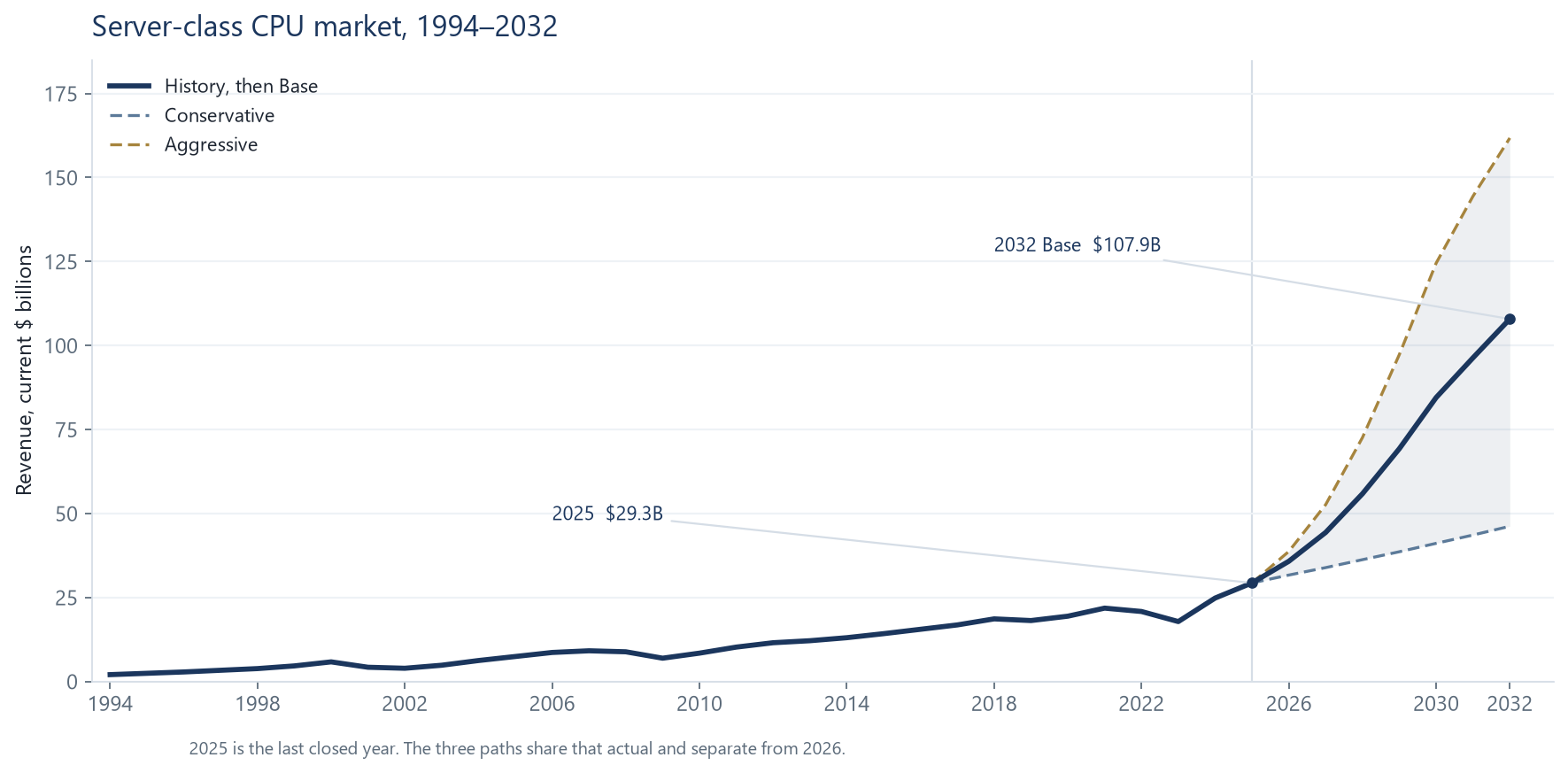
Market history opens at $2.0 billion in 1994, dips with the 2001 and 2009 recessions, and reaches $29.3 billion in 2025. Our base forecast is $107.9 billion in 2032, a 20.5 percent compound rate from 2025, with $84.5 billion at the 2030 checkpoint. The downside case, a replacement cycle, ends at $46.2 billion. The upside case, the agentic-CPU case, ends at $161.8 billion. These figures are current dollars of CPU revenue, not a stack of accelerators.
Data set details
The model. History holds every year from 1994 through 2025: revenue, sockets, average selling price, and a split of dollars across Intel, AMD, IBM POWER, SPARC, and everyone else, plus unit shares, the flagship core count, and a typical power envelope.
The forecast. The forecast holds 2026 through 2032 for downside, base, and upside: revenue, year-over-year growth, sockets, and average selling price. Sockets in the forecast are revenue divided by price. They are not a separate unit forecast.
Key players. Sixteen makers carry a revenue line: Intel, AMD, Amazon, NVIDIA, Ampere, Huawei, IBM, Google, Microsoft, Alibaba, Fujitsu, Qualcomm, other China suppliers, the RISC-V group, Oracle SPARC, and Arm Ltd. Base revenue is published every year from 2025 to 2032. Downside and upside dollars are published for 2032. A wider set of 29 profiles covers merchants, captives, IP licensors, and names that have left the market, including headquarters, instruction set, foundry, flagship part, and business model.
Key buyers and segments. Five buyer groups (hyperscale and cloud, enterprise, HPC and AI-host, telco and edge, government), five regions (North America, China, Asia-Pacific excluding China, Europe, and the rest of the world), and four instruction sets (x86, Arm, POWER and SPARC, RISC-V). Each has a 2025 share and a 2032 share in every scenario. The years between are a straight line. An AI-host series separates the CPU next to an accelerator from the general-purpose CPU, and a long-run index tracks flagship cores, power, and performance per watt back to 2017.
The products. The product catalog has 91 flagship SKUs from 1994 to the current generation, with cores, clocks, power, memory, process, and list price where those were published. The roadmap has 30 coming and 2026-generation parts. A blank cell means the vendor has not published that specification. The roadmap does not drive the revenue forecast.
Narratives and documents. The data set is accompanied by articles that explain the method, the drivers, the constraints, the base forecast, the companies, the disclosures to watch, and the vendor roadmap.